VIPER 11 began as an attempt to recreate one video: a GoPro clip shot from behind an F-16 pilot’s head on a takeoff from a desert runway. That clip did not look like a flight simulator. It looked like footage, and footage has a signature. The lens bends the horizon. The sun flares across scratched plexiglass. The colours lean teal and orange, and the exposure breathes as the sky fills the frame. None of that comes from a camera here, because there isn’t one. Each piece is a deliberate imperfection, rebuilt in a shader.
A lens wider than a lens
An ordinary game camera is a pinhole. It keeps straight lines straight, which sounds good until you widen it. Push a pinhole camera past about 120° and the edges smear outward without limit, so a pinhole can never see 180°. A fisheye gives up straight lines to see further. The game’s frame is 165° across a 2.39 : 1 letterbox, wider than the clip’s GoPro.
The catch with a plain fisheye is that it bends the middle of the picture too: the HUD, the instrument panel and the runway ahead, the very things you need to read. So the game uses a custom profile. Inside 28° of the centre it behaves exactly like a normal lens. Beyond that, an extra term adds the rest of the field, and the compression grows toward the edges. The middle stays honest and the sides do the bending.
Figure 1 · The mapping
No single camera render can cover 165° without wasting most of its pixels on stretched edges. So the game renders three views: a centre view covering ±50° and two side views yawed out to about ±66°, each with its own sky, clouds and cockpit. They are cross-faded where they overlap, and the lens pass reassembles them into one curved image. The side views cost about 45% more frame time, and that cost is the real price of the look.
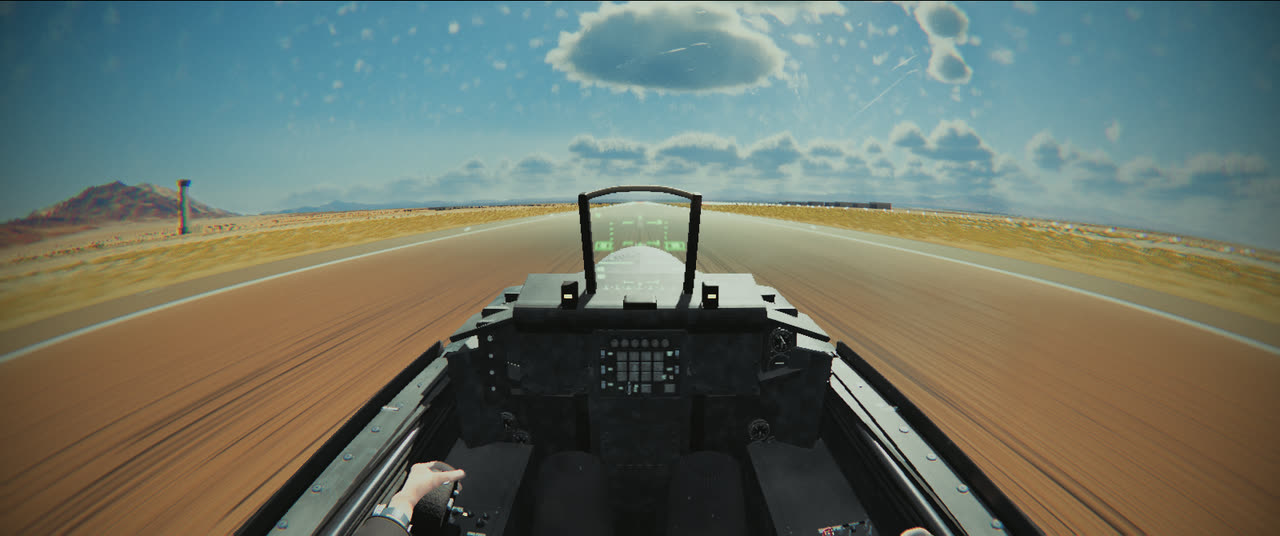
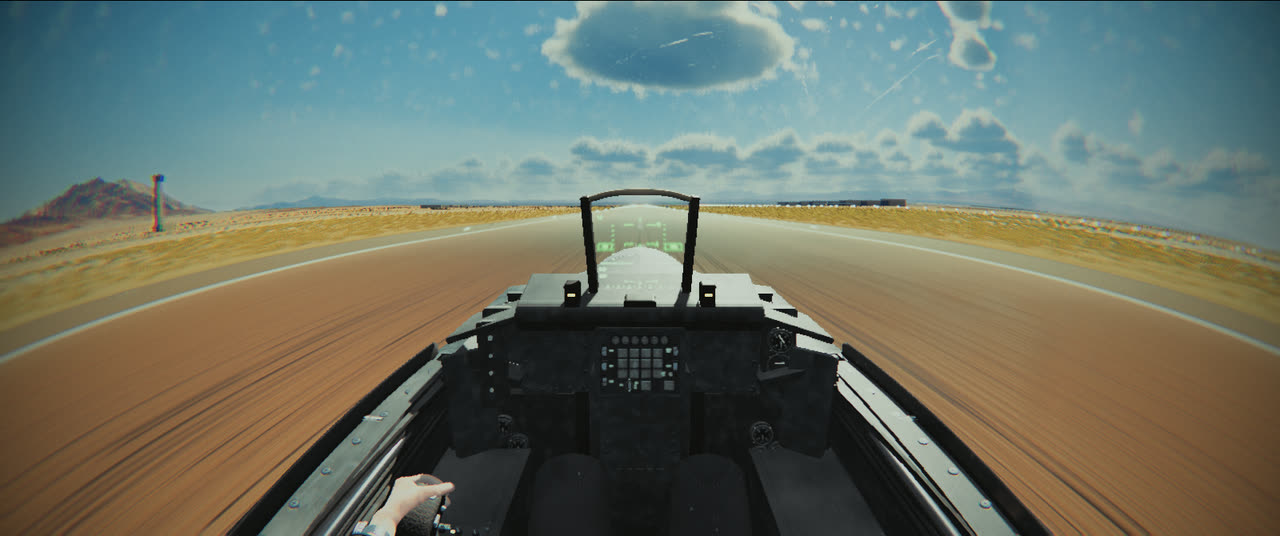 Plain fisheyeGame profile
The canopy
Between the GoPro and the sky there is a bubble of polycarbonate that has been cleaned with a rag a thousand times. You never notice it until the sun swings into view, and then every hairline scratch lights up. The game draws the canopy glass with its own shader, at three-quarter resolution, as a layer of its own:
- Scratches are a field of tiny grooves, each with a direction. A groove catches the sun only when it runs at right angles to the line between the sun and your eye, so the scratches light up in arcs around the sun, within about 32° of it, just as real ones do.
- Smudges, dust and a haze film glow when the sun is on them and vanish when it isn’t.
- Reflection. The inside of the cockpit is captured into a cube map every two seconds. The glass mixes in a reflection of it according to the Fresnel equations, so the reflection is faint looking straight through and strong at grazing angles. A faint gold tint stands in for the real canopy’s coating.
- Droplets form in cloud, slide aft and stretch with airspeed, bend the image behind them, and evaporate.
Light that misbehaves
Real lenses scatter light. A bright sun bleeds into its surroundings (veiling glare). It throws ghosts of itself along the line through the centre of the frame, it spikes into a six-pointed star from the aperture blades, and in the clip it draws a faint horizontal streak. The game does all of these from the actual bright pixels, so clouds and the canopy frame block them as they should. Bloom comes from a six-level blur chain that starts only well above white. God rays are a radial blur toward the sun of the open sky, strongest when the sun is half hidden.
Figure 2 · Layer by layer
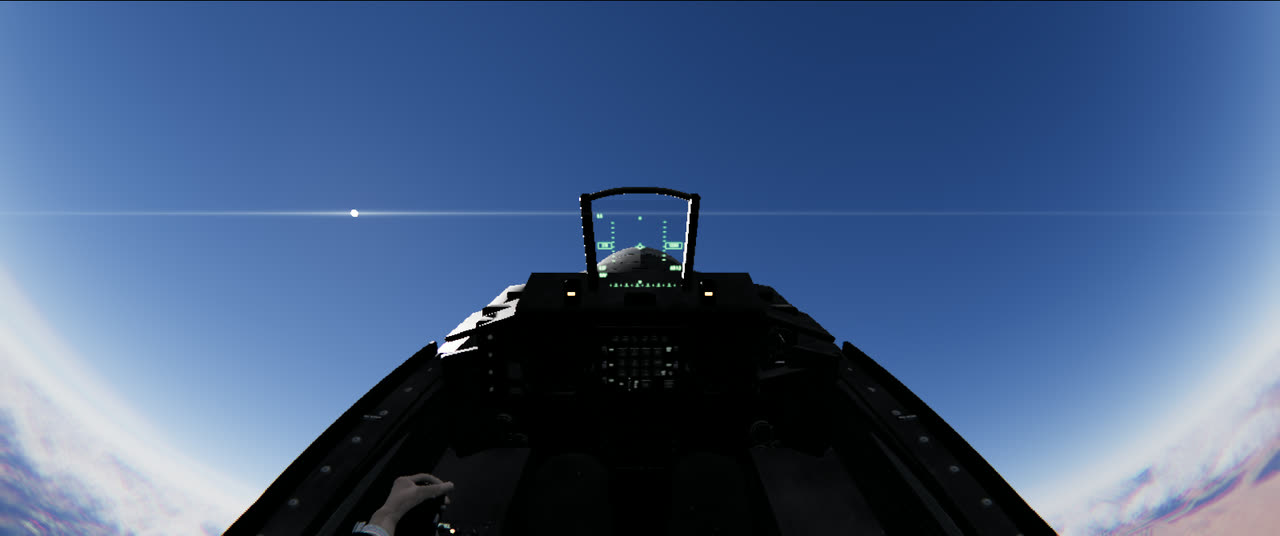
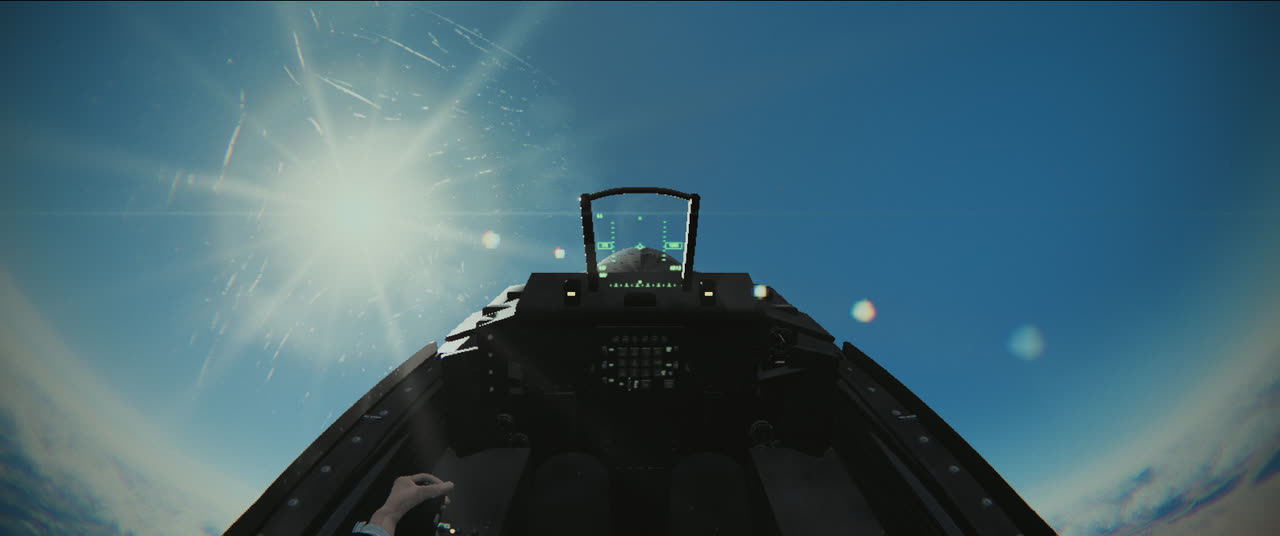 RawLayers
Exposure, grade and grain
A GoPro meters the scene and adjusts as it goes. The game does the same. It takes a log-average of the brightness of the world, leaving out the cockpit, counting the open sky at only 30% and the ground ahead a little extra, and eases the exposure toward it over about 1.2 s, within a range of 0.6–1.6×. Pitch up into a bright sky and the cockpit sinks into shadow; roll toward the desert and it lifts again.
Then the colour. The image stays in high dynamic range all the way down the chain and is tone-mapped exactly once, with ACES. A split tone pushes shadows toward teal and highlights toward warm orange. Then a 33 × 33 × 33 lookup table finishes the job. That table was not drawn by hand. It was fitted: frames from the game were matched region by region to frames from the reference clip, using a statistical technique called sliced optimal transport, and the result was smoothed into one table. The cockpit is treated a little differently, with a 1.7× exposure lift and its darks pulled back toward neutral, so that the grade’s teal doesn’t turn the instrument panel navy. Last come a vignette and a fine film grain.
Figure 3 · The chain, in order
The letterbox
The frame is a fixed 2.39 : 1 cinemascope strip, centred on whatever window you have, with the page’s own black for bars. It is a framing choice, and it also saves work: nothing is rendered where the bars are. Hold a phone upright and the letterbox drops away. The same lens turns on its side, about 70° across and 124° tall, and the two outer views are pitched up and down instead of yawed left and right.
The lens is what makes VIPER 11 read as a recording rather than a game. Each part on its own is a defect a camera maker would try to remove.