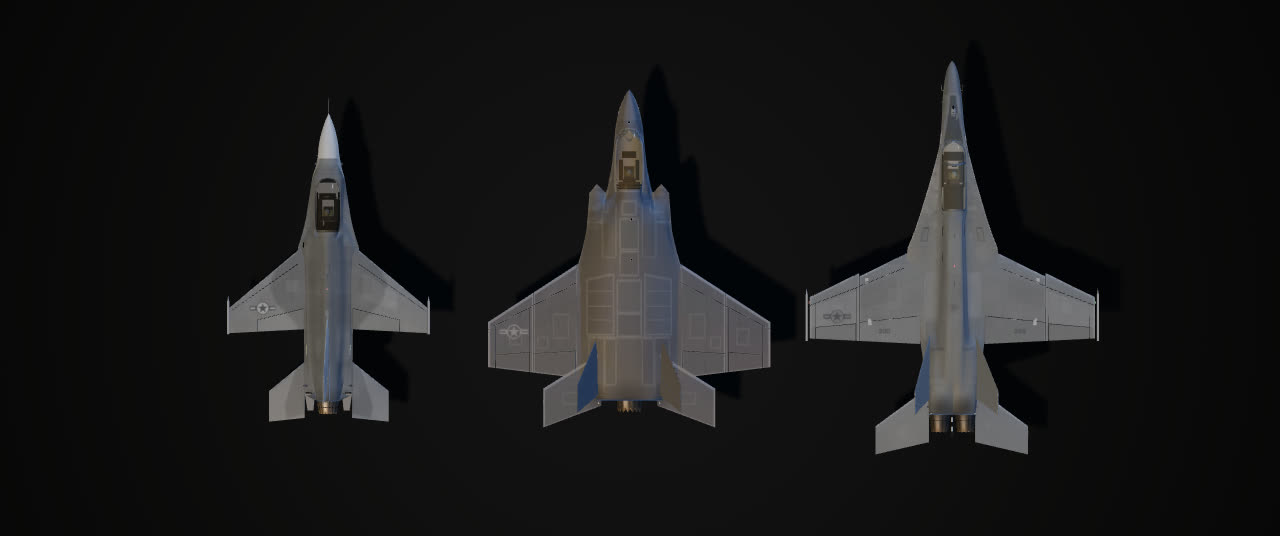
For a long time VIPER 11 had one jet, and you only ever saw it from the inside. Now the hangar has three: the F-16C you have always flown, the Navy’s F-35C, and the F/A-18E Super Hornet. None of them came from a 3D model store or a sculpting program. Each one is a few thousand lines of TypeScript that build the airframe when the page loads, from numbers someone looked up.
Start with the facts
Every jet begins as a reference pack: a fact sheet and a handful of images, kept in the repository next to the code. The fact sheet covers dimensions, weights, engines, control surfaces, gear, cockpit and paint, and every line says how far it can be trusted: official, a reputable ref, weak (a forum or a model kit), or our own estimate. The F-35C’s length, 15.70 m, is official. Its folded span, about 9.1 m, is weak, because nobody publishes it.
The images are the other half. An image model draws one master view, three-quarters from the front, from a short list of facts that must hold: two canted fins, a two-wheel nose gear, no gun bump. That master is locked, and the side, front and top views are edited from it, so all four show the same aircraft. Each view is measured before it is kept. The F-35C’s top view came out at a span-to-length ratio of 0.84 against a real 0.835, so it stayed; an earlier one at 0.76 was thrown away.
Even the kept images are wrong somewhere, and the pack writes down where. The F-35C’s top view shows a tailhook you couldn’t see from above. Every Super Hornet image makes its fins too tall. So each pack carries the same instruction: lock the proportions to the numbers, not to the pictures. The pictures settle what numbers can’t, like where a panel line runs.
Built from cross-sections
The fuselage is built like a boat hull. At a few dozen stations along the body, the code describes a cross-section: a chain of points round the right half, from spine to belly, with a curve between each pair. Where the curve passes smoothly through a point, the skin is smooth. Where it turns, there is a crease: a chine, the hard edge along the F-35’s nose. Each point is then interpolated along the body with a curve that never overshoots, so two stations a couple of centimetres apart make a crisp intake lip.
Wings and tails are thin surfaces built from their outlines. Gear, doors and nozzles are tubes and plates. The paint is drawn on canvases, in metres, as seen from above, below and each side, then projected onto the jet from where each point sits at rest. So when a wing folds, its stars and panel lines go with it.
Each jet comes in two levels of detail, one for close up and one for a jet far away in the sky:
- F-16C: 73,900 triangles in 36 draw calls close up, 7,700 in 4 at a distance.
- F-35C: 63,300 triangles in 39 draw calls, 7,100 far away.
- Super Hornet: 86,100 triangles in 52 draw calls, 9,900 far away.
Building one, paint and all, takes about half a second on a fast laptop, from 2,200 to 2,500 lines of code per jet.
Everything that moves
Every part that moves on the real jet is its own named node, hinged on the line it really turns about, and one call drives them all: jet.set({ gear, canopy, hook, fold, … }). The game, the menu’s turntable and the trailers all use it, with the same names and signs on all three jets.
The values are fractions, and each jet decides what a fraction means. At gear: 0.5 the doors are already open: they take the first 30% of the travel and the legs the rest. fold: 1 stands the F-35C’s outer wings up at 90° and the Super Hornet’s just past vertical, at 100°. The F-35C’s canopy hinges at the front; the other two hinge at the back.
Figure 1 · The jets, live
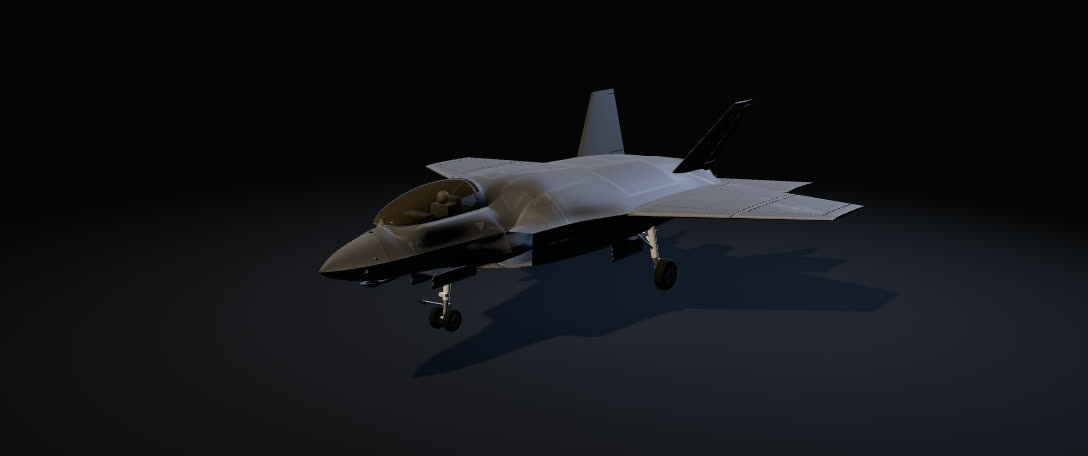
This figure needs WebGL, which this browser didn’t give it.
set() the game does. The F-16 has no wing fold: it was never meant to go to sea. With the gear down, the Navy jets’ launch bar drops with the hook, as it would on deck.Why not a generated mesh
You can ask a model to turn pictures into a 3D mesh, and sometimes that is the right call. The pilot’s gloved hands and flight suit were made that way, because hands are soft and hard to describe with numbers. A jet is the opposite: exact measurements, and parts that move.
- It has to move. A generated mesh is one fused shell. Cutting a flaperon out of it and filling the hole is more work than building the flaperon.
- It has to be the right size. A generated jet is the shape of its pictures, and the pictures are wrong. The canopy has to sit exactly where the cockpit expects it.
- It has to be small. A jet’s code is 40 to 60 KB of minified JavaScript, and it paints its own textures. A detailed mesh with textures runs to megabytes.
- It has to be fixable. When photos showed the F-35C’s markings reading lighter than its coating, not darker, that was a small change to the paint code, not a repaint.
The cost is time. Most of the work is looking at a render next to a reference and moving a number by a few centimetres.
The F-16, rebuilt
The F-16 was the hardest, because it already existed. Its cockpit came first, built to match a real cockpit clip, with just enough airframe to be seen from the seat: nose, canopy, strakes and wings. On the menu’s turntable it was a stand-in made from that shell, with the cloud-shadow proxies for a tail.
Its full exterior had one rule: the cockpit is the anchor. The radome, forebody and canopy are imported from the cockpit’s own code, and the airframe hangs off one offset from the pilot’s eye, 2.55 m up and 4.12 m ahead of the main wheels. A check image draws both silhouettes from the GoPro, in cyan and red, white where they agree. Everything new fits round that: the Block 50’s big-mouth intake, the blade antennas on the nose, the split speedbrakes.
Three cockpits, one piece of glass
From inside, each jet has to feel like itself within a second, and most of that is what frames the view. The F-16 has nothing over your head: a bubble from nose to seat, a tall HUD, a side-stick at your right hand. The F-35C has no HUD at all. Its symbology is in the helmet, so the glareshield is low and bare, and one 20 × 8 inch touchscreen runs across the panel. The Super Hornet has an arch: a wrap-around windscreen and a thick bow overhead with mirrors and grab handles. Under it are a low-profile HUD, one 10 × 19 inch display, a centre stick and two throttles.
Figure 2 · From the seat
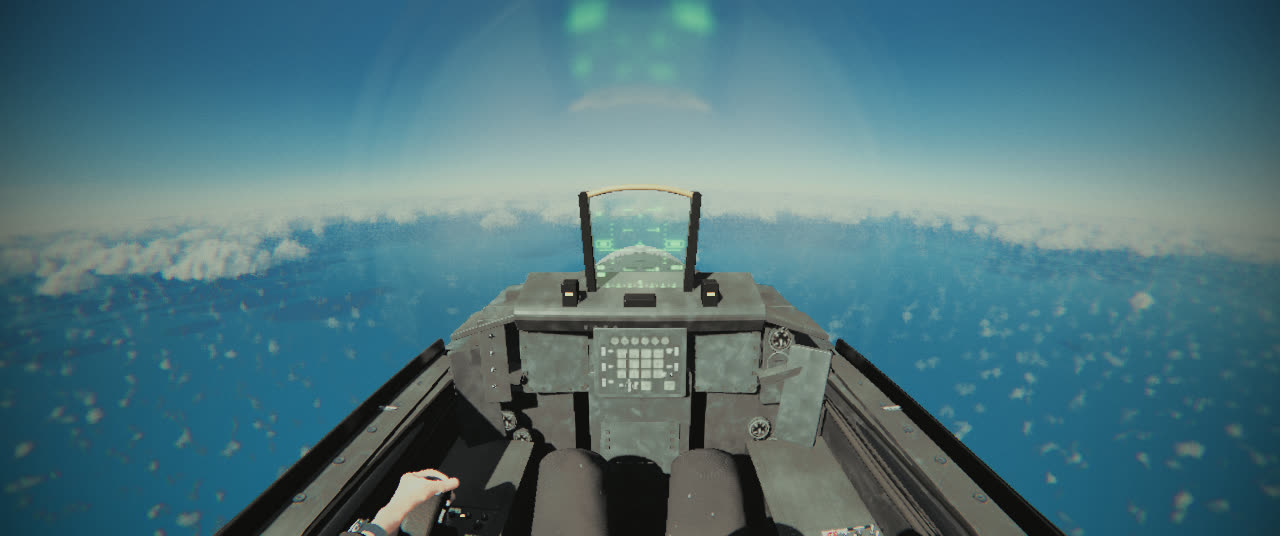
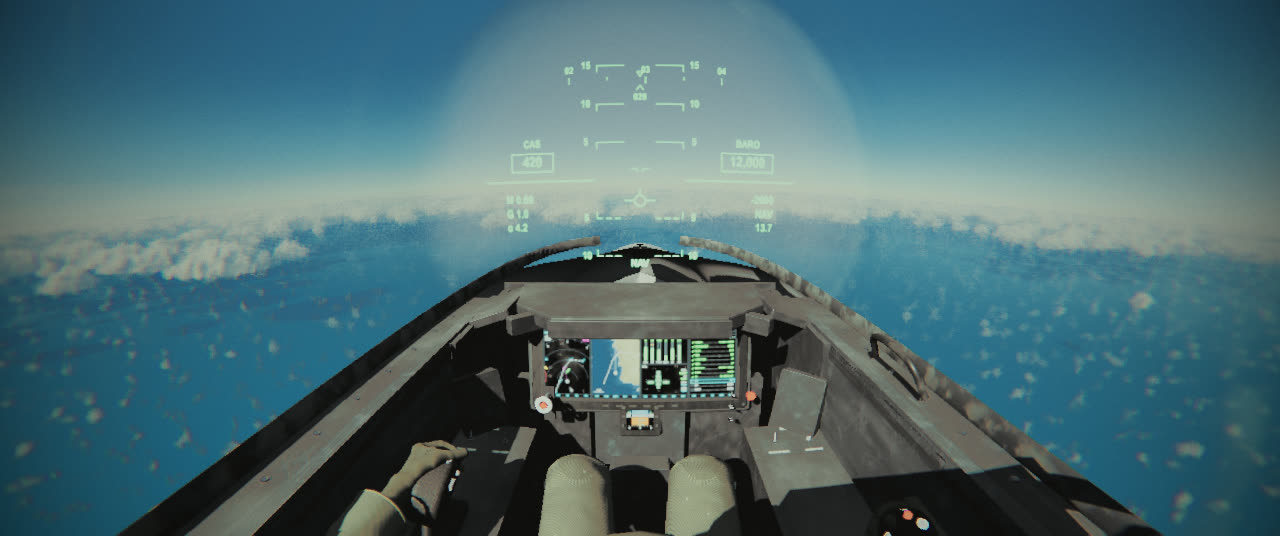
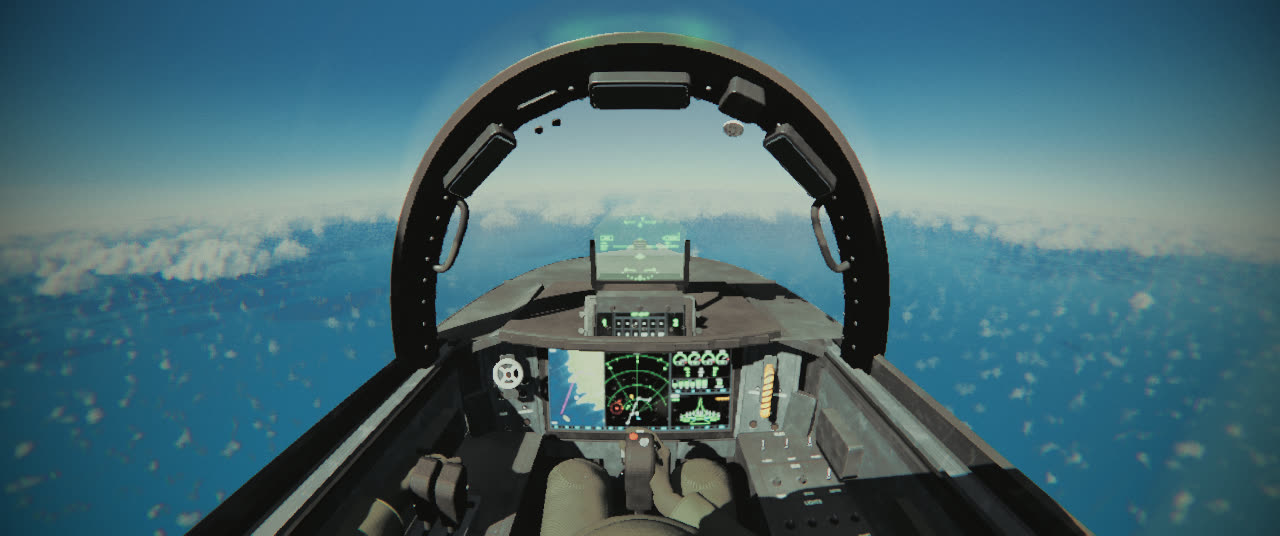
What they share is the physics of the glass. A canopy in VIPER 11 is a coated polycarbonate sheet with two reflecting surfaces, Fresnel for a refractive index of 1.585, scratches that light up in arcs round the sun, smudges and dust, droplets that slide aft with airspeed, and the cockpit and helmet reflected inside it. None of that cares about shape. So each jet hands the lens a short list of glass pieces: a surface, a sheet size for tiling the scratches, a coating colour and strength, a reflection blur, and how scratched, smudged and dusty it is. The F-16’s is the default. The F-35C’s is longer and flatter, with a stronger gold. The Super Hornet’s is near-clear.
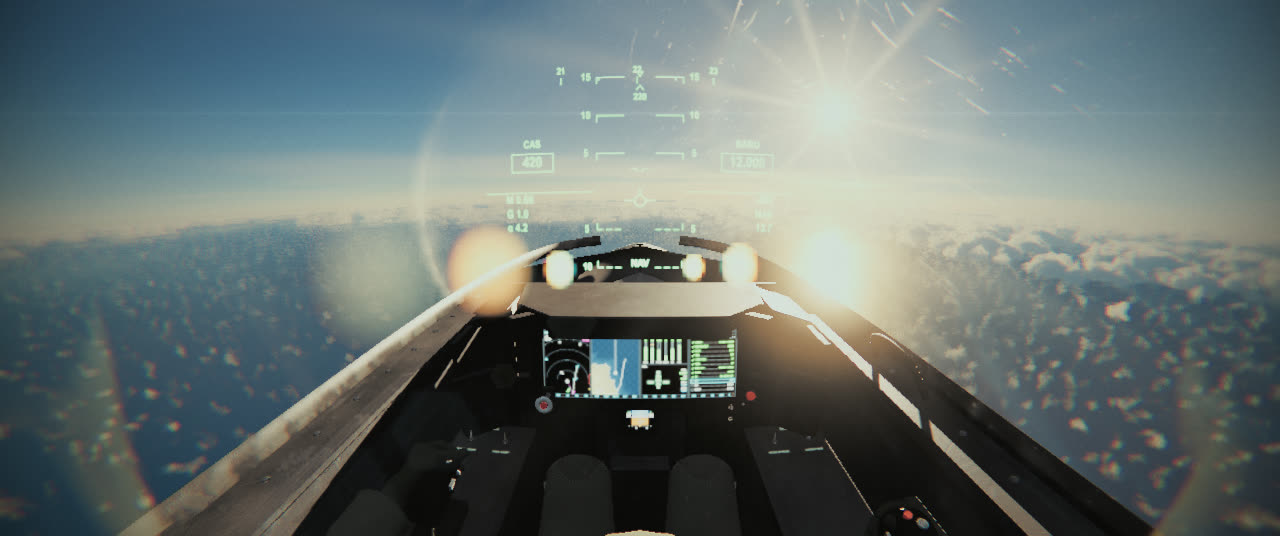
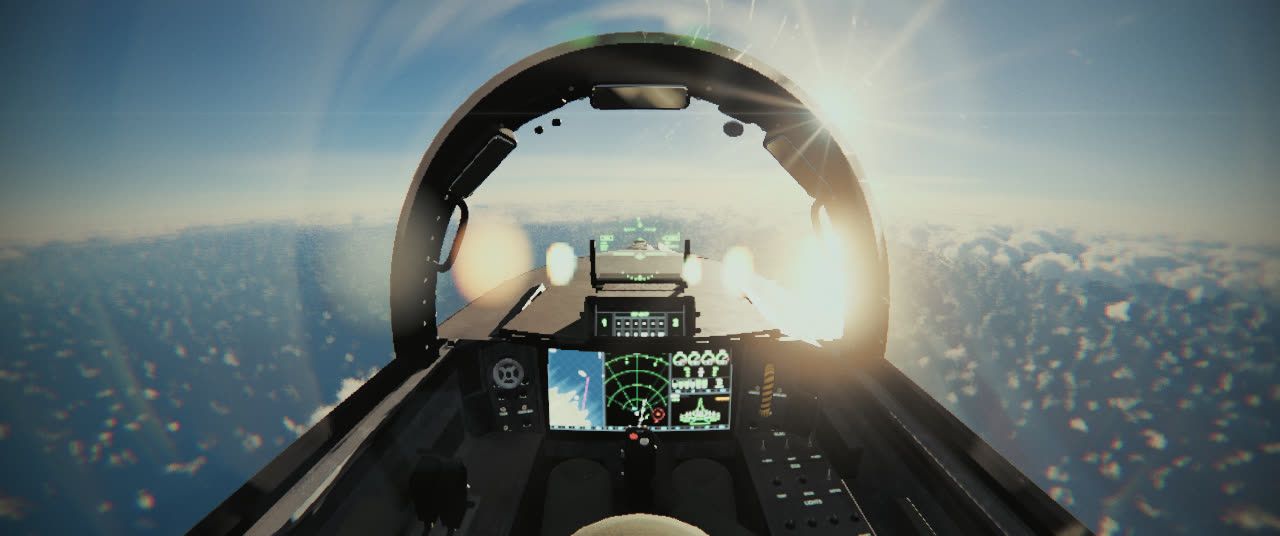 F-35CSuper Hornet
One small difference is kept on purpose. A HUD is real light on real glass, so the F-16’s and the Hornet’s show faintly in the canopy’s reflection, a green ghost overhead. The F-35’s symbology is inside the visor. It sits on a layer the reflection cameras can’t see, so it never reflects, and it blanks where it would cover the panel display, as the real helmet does.
Not everything is finished. The Hornet’s windscreen should be sharper and cleaner than its canopy, but the lens still draws one piece of glass. For now both are cut from one surface, the bow hides the seam, and the canopy’s optics serve for both. Each piece already carries its own numbers for when the lens can draw two.
Flying them
The F-35C is in the plane picker now, with its own flight model, its own engine sound and the helmet display. The Super Hornet is built inside and out, and you can see it in the figure above. Flying it is next. It needs its own flight model, with an on-speed approach at 8.1° angle of attack against the F-35C’s 12.3°, and the sound of two engines instead of one. It will be in the hangar soon.